


March 31, 2026
Dog Meets Baby: Podcast Episode #336
Bringing home a new baby is a major transition for the entire family, including your dog. In this episode, we sit down with Dominika Knossalla-Pado, certified dog trainer and founder of Dog Meets Baby, to talk about safely preparing your dog for life with a newborn.
Dominika shares her personal journey into motherhood and how her own experience inspired her work helping families create safe, positive relationships between dogs and babies. She offers practical, real-life strategies for introducing your baby to your dog, recognizing stress signals, and preventing common challenges before they start.
We also explore how doulas can support families navigating this transition, the emotional side of bringing home a baby with a pet, and why preparation is key to creating a calm and confident household.
In this episode, you’ll learn:
- How to prepare your dog before baby arrives
- Tips for a safe and successful first introduction
- Common mistakes families make (and how to avoid them)
- How to read your dog’s body language and stress cues
- The role of doulas in supporting families with pets
Whether you are expecting, newly postpartum, or a birth and baby professional, this episode is packed with actionable advice to help both your baby and your dog thrive together.
This episode is sponsored by Cozy Earth. Use the code GOLDCOAST to receive a discount of up to 20 percent off.
Hello, hello! This is Kristin Revere with Ask the Doulas, and I am thrilled to chat with Dominika Knossalla-Pado today. She is a certified dog trainer who graduated with honors from the prestigious Academy for Dog Trainers.
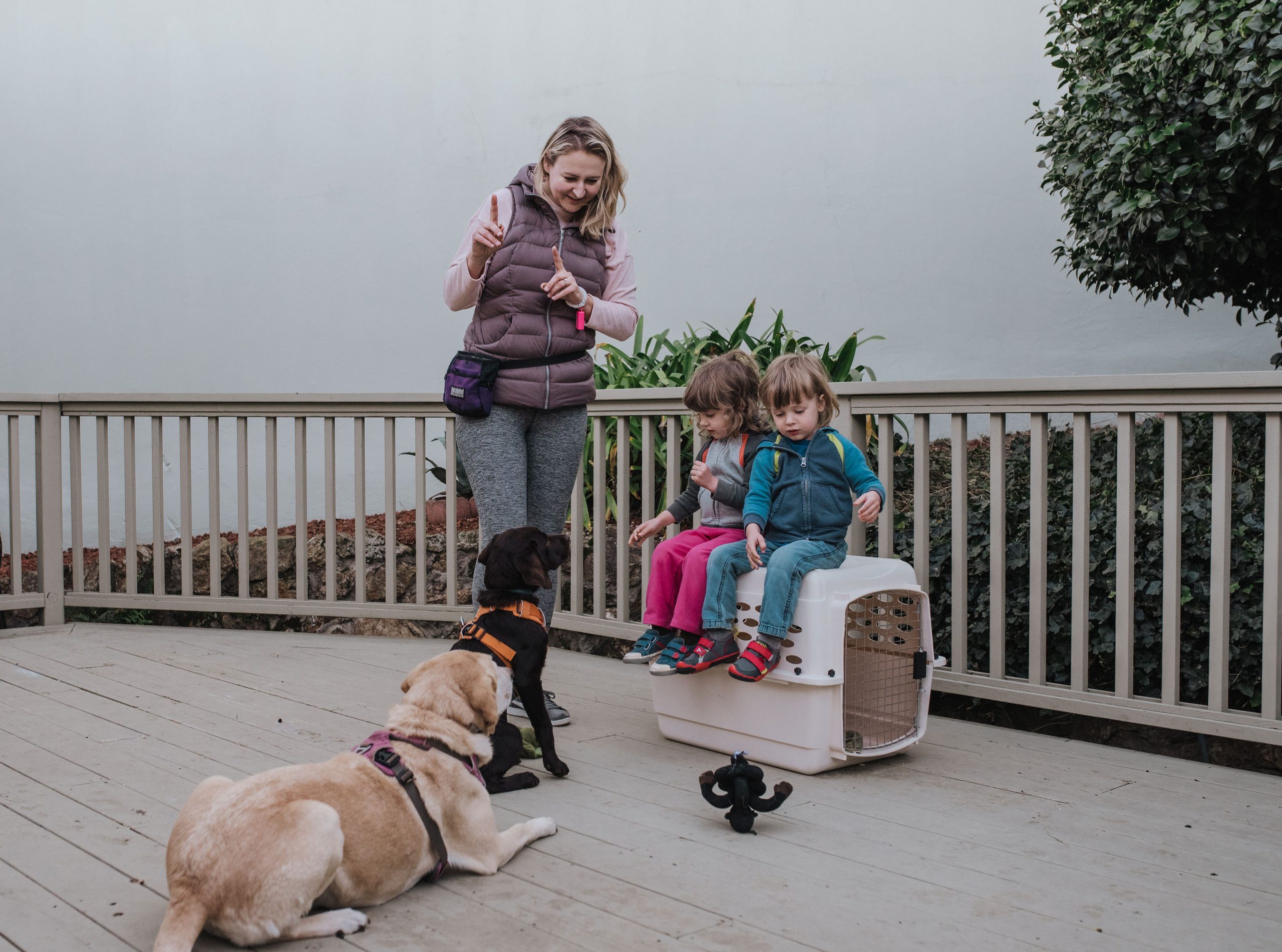
When her beloved Labrador, Lola, showed predatory behavior toward her newborn twins, Dominika realized most parents lack the tools and knowledge to navigate these moments safely. This experience inspired her to found Dog Meets Baby, now a trusted resource for families worldwide through their online courses, consultations, and free resources.
As her twins grew into toddlers, their unpredictable movements scared even well-trained Lola. Searching for a way to keep everyone safe without constant separation, Dominika combined her professional expertise with her children’s love of bubbles to create the innovative Bubble Concept. This simple idea that all animals have bubbles that keep them safe became the foundation for Lola and the Bubble Mission, her first children’s book.
Welcome, Dominika! It’s so lovely to have you here!
Hi! Thank you so much for having me!
I know our topic may branch off into other discussion points, but we are going to chat about Dog Meets Baby and that big transition of bringing baby home, and also diving into preparing for the other visitors and nannies and doulas who may be meeting the dogs. So not just the baby preparation, but all of those postnatal guests or professional experts in and out of the home.
Yes. Ask away, I’m happy to answer any questions you and your audience might have!
So from your personal experience and your passion for that big transition point, whether it’s newborns and dogs or the toddler phase, I would love to hear some of your tips for families who have a dog or multiple dogs at home and are getting ready for the first moment of bringing baby home and how to focus on safety and also connection for the pets.
Yes, that’s a great question. I always tell parents that even if your dog is an angel, and many people would describe Lola as a dog that would not hurt a fly. So if you have a dog like Lola, I still recommend that you have a plan for how your dog is going to meet your baby. And if you have time, to practice this, so you can test various options that work best for you and your dogs. So it’s very important that you have a plan for your dog when you are in labor. And it’s not just one, because many things can go wrong and babies don’t come on their due date. Always have a plan, A, B, and C. Make sure that if this person is not responding and you have to go to the hospital in the middle of the night, you also can call someone else because I know from my experience and other parents that I have talked to, and other doulas that I have talked to, that many moms will be very stressed because they don’t know what’s going on with their dog and they’re in labor and the labor is stalling and it’s just not a good headspace to be in when you’re about to have your baby. So just have a plan so you can relax and focus on you and your baby. And when the baby is born – and even with homebirth, it’s also very important that you have a plan. Many dogs will struggle with how you will be acting, and they might get really stressed. And you may not want the dog to be there. Or some dogs don’t really do well with strangers in the house, and that can be very stressful. Some dogs especially with pregnant moms, they become very protective. It’s a normal reaction, and they may not want the doula to be so close to their mom. It’s not a good scenario. So always have a plan. Who is going to take over the dog? Where is the dog going to stay? And that’s both for homebirth and for when you go to a birthing center or the hospital. Because that’s going to give you peace of mind.
Exactly. And when I’ve attended home births, there have been a few different scenarios. Some dogs are older and very laid back, so it doesn’t affect them. Others, like you said, they might get a little skittish or protective, and sometimes depending on the midwife, there could be apprentices and assistants and there might be a doula there. And so a lot of other people. Sometimes there’s a birth photographer. I’ve often had family members come and pick up the dog and take the dog for the labor portion and the early bonding phase. Sometimes there’s a finished basement where the dog can hang out with another family member or a friend and be let out without interrupting the flow of labor. Sometimes there are other kids in the home during a home birth.
It’s true. It’s very important that when you plan for the home birth or the hospital birth, that you take all of this into consideration. So the way you would plan it for your older child – who is this child going to be with? – the same way, plan for the dog. Because sometimes, even the most laidback dog might still have a reaction. It’s not something that I want a mom, a laboring mom, to be thinking of.
Right. And as you mentioned, birth can be unpredictable. Even planned surgical births might happen before that planned date, and so having people to call, knowing the schedule of the dog, and sometimes it’s just coming over and letting the dog out and feeding the dog. But some births can be longer than expected. It can be an induction that’s multiple days. So as you mentioned, having a plan in place so it doesn’t worry the laboring mother and the partner. It is best to get everything worked out before you go into labor and that water breaks or you need to head to the hospital if it’s your third baby and things move very quickly.
Absolutely, yes. Always have a plan. Always have a backup plan or even multiple backup plans. Because things can happen, and the person that you booked for your dog – like, this happened a lot during COVID, that people that were supposed to take care of the dog couldn’t get there because they were isolating or sick. So it’s something that you have to think about. Or the doggy daycare was closed. Right now, it’s less of an issue, but still, things can happen. People can get sick. We’ve had quite the flu season this year. It has been quite a lot with many people getting sick. So it’s really important that it’s not just one person on your list, but another person. Let’s say this person has to get to your home while you’re already in the hospital. How are they going to enter your house? Do they have the keys? Do they know the code? I have a free resource, the Dog Meets Baby Preparation Checklist. And this is something that I share there, all these little things that are so easy to miss. Because it was my dog walker who was taking care of Lola, but I had to go to the hospital sooner. Everything was really rushed. It was semi-emergency because I had preeclampsia. And she luckily had the keys because she was my dog walker. We literally had an hour to pack and get to the hospital from the moment the doctor called. So it’s just something that, if it had been someone else and I was counting on that person, it would have been different. Like, we also had to plan, what if I have to go to the hospital in the middle of the night. Who can I call? Because I knew that my father-in-law, he probably would be asleep and he wouldn’t pick up the phone. So the little details, making sure that your dog is going to be safe, because to many of us, dogs are our fur babies. And it’s very stressful if we have to leave and we’re a little bit stressed, like I was, and then not to know what’s going to happen to my dog and when is this person going to come.
Exactly. I find that as you mentioned, that instruction sheet, for any caregiver who’s helping out, whether it’s a family member, dog walker, or there are some services that can come to your home and take the dog out to dog parks and so on – yeah, just getting everything from how to enter, where the dog will be, how the dog will greet you – or is the dog going to be in a crate, for example? All of those details are helpful. And then with our overnight postpartum doulas and newborn care specialists, we’re often arriving late at night, so when we are helping care for baby and the mother, we have a checklist, as well, of how to enter the house. Are there dogs? Do the dogs have any fears or concerns? That way, we’re fully prepared for how the night is going to go and how to anticipate the needs. So yes, that is very helpful to have all of that information for a family member who might be popping in to check on the dog or let the dog out. Or again, a doula who could be entering at a time when the household is quiet and the dog feels like they need to be on high alert.
And also making sure that this person will be comfortable with dogs. I always tell parents, if you are hiring a doula, you guys have to meet, and the doula, ideally, meets the dog. So the meeting is not at a café; it’s at your house, or you go for a walk. I don’t want the doula to arrive when the mom just had the baby and this is the first time when the dog sees a stranger. Because I had a client where things absolutely did not go well, and the doula ended up canceling on them because the dog attacked her. And it was not the kind of dog that they could have anticipated that. The dog was a Labrador, generally a friendly dog. Not typical at all. But because of the change – the new baby in the house and the change of the routine – this is the reaction that the dog had to the stranger entering their house, and the dog attacked her. The doula was very scared of dogs, and this was just not going to work.
Yeah, and that makes complete sense to meet in person. The idea of a walk with the dog makes sense, if it’s just too much disruption for the doula to meet at the home in advance. And yeah, we like to arrive early for the first shift, so again, there’s a little bit of that notice and meeting the dog in advance if the dog is going to be roaming the house. Sometimes, as I mentioned, they’re kept in a room or in the basement, and the doula may not ever interact with the dog.
Absolutely. I just think it’s fair to both sides to know that there are dogs, to know where the dogs should be, and to get to know each other and to know if the dog can have treats or if there are any treats and what to do if the dog barks. A friend of mine is a doula and shared a story where the dog was supposed to be in the basement or in the crate. Anyway, the dog was not supposed to be in the house, and suddenly she sees the dog loose there at night, staring at her and growling. So of course, this is just also making sure – and in early postpartum, it’s so easy to maybe not remember to lock the door. But just making sure. This is not something that’s going to happen to everyone. But I always tell parents that if you have a dog that does not like strangers in the house, always have two layers of safety, not just one, because it’s so easy. When I had twins and I had an emergency C-section and one of my kids was in the NICU, it was a lot. So in the early days – I barely remember them. It’s so easy to forget to lock the crate or forget to put the dog away. So always have two layers of safety. There is a crate and a door. It’s not the crate. Maybe the dog is in the basement, and there is a gate and the door. Or the dog is in the crate behind the gate. For dogs who have known aggression issues towards strangers, it’s important.
It makes sense. I love the two layer tip. It helps, obviously, if a dog has been trained when you are dealing with other people in the household, introducing a baby or in your case twins. I know with both of the dogs I’ve had, I started with puppy school and we had trainings where they get used to other children, say, petting the dog and pulling and all of the things that a toddler might be doing when, as you mentioned, that protective bubble is ideal, but having that tolerance. So what tips do you have, even in the preconception phase, if you know you want to plan for children and you have a dog that maybe hasn’t been trained? What is your tip for getting them ready for other family members or a baby? Do you recommend training even beyond the puppy phases?
Absolutely. Yeah, I’m a trainer, so I love training. To me, this is something that I just do as part of my daily routine. My first dog, Lola, was very well-trained. My second dog is not as well trained. But it’s okay, she’s trained enough. So what I would recommend – I also want parents to listen to – let’s say you’re in the third trimester and you’re panicking, hearing me say, “Train your dog their whole life.” Think of this as a process. There is no deadline. Your dog should be trained by the time you’re going to have your baby. It is a process, and it will continue, and it will change. So it’s not something that you have to have it done by the time you deliver the baby. I want parents to see it this way. If you have time to train before you have your child – it’s also not about your dog knowing ten different cues and being great at them. If you want to do that, of course. What I recommend is choose something that’s going to be useful. And the ones that I find useful with little children is: go to bed. Stay. Leave it. We all know how many things get dropped. There are many toys.
Pacifiers!
Exactly, pacifiers. So leave it and drop it. These will be two very useful cues. And if you want to remove your dog off the furniture, teaching them “off” is also helpful, or “away.” But it could be just “go to bed.” Cues where you teach them to go to a certain location. So just have a few. Choose the ones that you’re going to need in your daily life. Once you’re pregnant, practice them while you hold something. Because remember, you will probably not be pointing – you might be pointing with your elbow, but you’ll be holding something, either your baby or something for the baby. You’re not going to use your hands the same way you are pointing right now. So hold something. It could be a bottle wrapped up in a baby blanket. Practice the voice commands and maybe using your elbow. I did that, and it was definitely very helpful because that was not a new picture to my dog. So it’s important that you introduce it before you have a baby.
What you mentioned, being comfortable with being touched – this one is a little bit tricky because there is no safe way to train it. Let’s say your dog is mildly afraid of children. I would not necessarily train with children that you don’t know, if your dog might do something to them, because that’s a liability. And you’re probably not going to be able to train with the age group that is the one that’s most scary for dogs, which are the newly mobile infants and toddlers. You’re going to be training with your friends or your cousins, maybe three-year-olds or five-year-olds. For a dog, it’s a huge difference. A three-year-old or five-year-old, it’s not a one-year-old. It’s not a crawling baby. So it’s a huge difference. Of course, you can have your dog around children and throw treats at your dog. If your dog happily approaches them, they can give the dog treats. Creating positive associations around the children, absolutely. You can make sure that your dog likes being touched and practice touching the paws and tail, but this may not translate to your baby grabbing your dog. So it’s not something that you will be able to really practice before you have your baby, and your dog might not be comfortable with your baby and how your baby will probably grab the fur and twist, or grab really hard and pull. There is a way to practice this, but I would say unless you follow the steps of how to do it right, you can actually sensitize the dog to certain things. You can sometimes make it worse. So if your dog is really comfortable with touch and handling, I would recommend talking to a professional so they can guide you so that you don’t end up with a dog that now absolutely does not want to be touched by anyone, because when they see you holding a treat, they know that you’re going to touch them, so now they stop eating treats. That can happen very fast if the dog is already a little bit skeptical about it. So that’s something. Of course, positive experiences with children, making sure that the children aren’t rough. Don’t take the dog to a birthday party of a two-year-old where there are ten toddlers running around and screaming. That’s going to be very scary to a dog. Unless it’s a puppy; maybe that would be okay if you do it in a controlled way. But for most dogs, what’s called flooding is a very negative experience. It’s not going to really help them to create a positive association. It’s the opposite. You’re going to really scare your dog. So it’s important that we teach them in a way that’s beneficial. A slower pace, more distance, good treats.
That is so helpful. I have a couple of questions related to that first meeting with baby and the dog, or multiple dogs. First, what are your thoughts about bringing something home that smells like the baby? Are you a fan of that? Like a little blanket or a stuffed animal?
There is nothing wrong with it if the parents want to do it. They can do it. But it is a myth. It’s generally not something that will change much. If you think about it, when you bring a blanket from the hospital, there are so many smells on it. There are people who touched it, the hospital smells. There is the scent of the baby, but it’s one of several scents. Now, you’re presenting it to your dog. To many dogs, when you show them something, their natural reaction is to grab it. If the dog likes to play tug of war, they might start playing tug of war because they think, oh, that looks like a new toy. Some parents have shared that the dog ripped it apart, and then they were extremely stressed out because they imagined that’s what the dog would do to their child. And some dogs don’t care, and some dogs cuddle with it as they would cuddle with a different blanket. It does not have much to do with the scent of the baby. You can absolutely do it. It’s not going to do anything. A single introduction to the item is not going to do anything. Now, the exception is, and I didn’t do it because my son was in the NICU for only five days. Let’s say you have your child in the NICU longer. Two weeks or a month, and you come home. At this point, you are home and you go to the hospital to see your baby every day. You can bring a baby item home with you, let the dog smell, give a treat, and then do it the next day. If you do it this way, your dog is definitely going to make an association with the baby smell because this is going to be a consistent smell among the other smells. They are able to recognize, oh, that one particular smell is always on the item that the parents bring with them. Plus, of course, there will be the baby smell on the parents, on their clothes. So it’s going to be the dominant smell. And this way, you’re exposing them to the smell, plus you’re pairing it with a treat. This is how you can create a positive association. But there has to be repetition.
That makes more sense, yes. I have heard that it’s false, but with the NICU and repeated visits, that makes a lot more sense.
What are your tips for entering the home with baby or multiples, like in your case, for the first time with the dog?
So here we have two options. Sometimes you enter the house, and the dog is somewhere else. That was our case. So the dog stays with a family member or friends or at the dog sitter. A lot of times – I would say it’s 50/50. Sometimes dogs are home, but a lot of times, they stay somewhere else. If your dog is not home, it’s going to be a different scenario. Ideally, whoever has the dog exercises the dog really well, takes the dog for a walk, so the dog is a little bit tired. Ideally, the dog meets the parents before meeting the baby. And most dogs are going to be very excited to see the dad or mom because they haven’t seen them for a while, especially the mom. You want them to be excited first around mom. And this way, they also smell the baby. The smell of the baby is on the mom. So this is a good, positive association with the baby and the first introduction to the smell, or one of the first introductions. And ideally, the dog first meets the car seat. Let’s say the baby is in the nursery or someone is holding the baby. You leave the car seat in the center of the room, and you let the dog smell it. If the baby has just arrived, there is a lot of smell in that car seat. Of course, I would recommend introducing the car seat before the baby is in it, so it is not a new object that they are not terrified of. That part is important. But having some items with baby scent is always helpful.
I know that many parents want the dog to meet the baby as soon as possible, but to be honest, you don’t have to. Especially if you have a two story house, and let’s say the baby is upstairs and you have a gate on the stairs – maybe you always had a gate, or you just decided to have it now – it’s fine if the dog is downstairs and hangs out with you and just maybe hears the baby a little bit and smells it in the house. They’re going to get used to the baby at a slower pace. That’s absolutely okay. Sometimes, it’s good to know that maybe you had something different in mind, but then in the moment when you brought the baby home, you’re suddenly anxious. What many parents tell me is, when I brought the baby home for the first time, I realized that I live with an animal that has a jaw full of teeth. Sometimes you may see your dog in a very different light. If you need time, take your time. You can keep introducing your dog to the baby blankets and the onesies and the hats, having them around, letting your dog sniff, hearing the baby. And when you’re ready, let the dog meet the baby.
There are many options, but the three main options would be the baby in the car seat, the baby in the nursery in the crib, or someone holds the baby.
That makes sense, with it being based on comfort level and the temperament of the dog, of course?
One dog at a time. There are some exceptions to this rule, but for the most part, you want the dogs to meet the baby separately. A lot of times, their reaction is not going to be the same. This way, you will know, oh, this dog is totally chill and doesn’t care. Sometimes parents tell me, I don’t think the dog noticed that there was a baby. Like, some dogs just really don’t care. Sometimes they start noticing the baby later. Whereas some dogs, they bark or they whine or they look very stressed, and you don’t want the other dog, that would have been super chill otherwise, now to pick up on this energy and start the same behavior. And many times, they will do this.
I worked with a family with two yellow Labradors, and one didn’t care about the baby. The other one did. Because they met the baby together, they were both barking and jumping. Very bonded dogs, very bonded with each other. So they were both like, I’ve got your back! Yes, let’s bark and jump. And they looked terrifying, two giant dogs, big Labs, trying to get to the baby. And the second one was a good companion.
That makes sense. So many good tips, and I know you have amazing trainings that are virtual, so our listeners who live all over the world can take advantage of working with you. They don’t have to just be local to you for in-person trainings?
Yes, that’s true. For expecting parents, we have two online courses: the preparation course covers the preparation and the training. Then there’s the first meeting course, a shorter course that focuses on the first meeting, what to do before the first meeting, all the necessary information. And the fourth trimester, or the first week at home and the fourth trimester.
We also have a private group for participants, and it’s very supportive. Such a nice group of parents who get it. Because when you have a dog or dogs and a child, it’s not the same as just having a child. A lot of times, you feel guilty that you don’t have time for your dog. There are just so many emotions. As a new mom, you can resent your dog. You can feel guilty. You can grieve the relationship that you had. And it’s good to have a support system from parents who also go through this or who went through this and now they are on the other side. So I find this group very supportive, and I know that many parents do, too.
And you have access to me, the trainer, in the courses, too. I have people always asking questions. Every dog, every household, is different, and while the course covers as much as we could, there are situations that we’re not going to cover because it’s very specific to you. I mentioned earlier, there are exceptions to the rule of let’s have the dogs meet the baby one at a time. There are absolutely cases where I would say no, they have to meet together. These two, based on what you told me, I recommend they meet the baby together.
And you can learn from other people in the group. That’s what I love about community.
Yes, me too.
So your website is Dog Meets Baby? And then Dominika, you are all over social. You’ve got a great YouTube channel. Tell us how we can find you on social media.
Yes, I have a YouTube channel. I would say I post more on Instagram right now, but the YouTube channel has training videos on things like how to introduce a stroller to the dog. Pre-baby training videos. But otherwise, on Instagram, I’m @dogmeets_baby.
Excellent. And you mentioned the checklist, and we will include that in the show notes.
I would say the checklist is a good starting point, and there will be things that you will be able to check off right away. That’s the whole point. Most parents, I don’t want them to feel like, oh, this is too much. No, there are many things that your dog probably already knows. There are certain things that it’s just the planning, like a key for the person picking up the dog, or a code. Just making sure that you have a plan here. And the other one that’s very important that’s also a freebie – Baby Sound Library, recorded by the moms from my community. We have all the possible baby sounds there, including different types of pooping, because pooping is one of those sounds that scares dogs. So you really want to make sure that your dog hears it before, that explosive poop, and different types of crying. Many people make the mistake that I, before I had my children, I also didn’t know – that newborn sounds are different than a six-month-old cry. So it’s very important that you introduce your dog to the newborn sounds. I think we even have some preemie babies there, too. So it’s important that your dog hears it all, not just a loud crying one-year-old.
So many great tips! I’ll have to have you back on again to talk about toddlers in the future! But I appreciate your time. Do you have any final words of wisdom to share with our listeners, Dominika?
Yes, I would say that having a child and a dog can be challenging at times, and it’s a lot of work. There will be many emotions. But there is something so special when you see your child and your dog bonding, and you are not part of that bond. When you see them having that relationship, just watching that is just magical.
I love it. Well, thank you again!
IMPORTANT LINKS
Birth and postpartum support from Gold Coast Doulas